

POM Costing
Costing & post-calculation
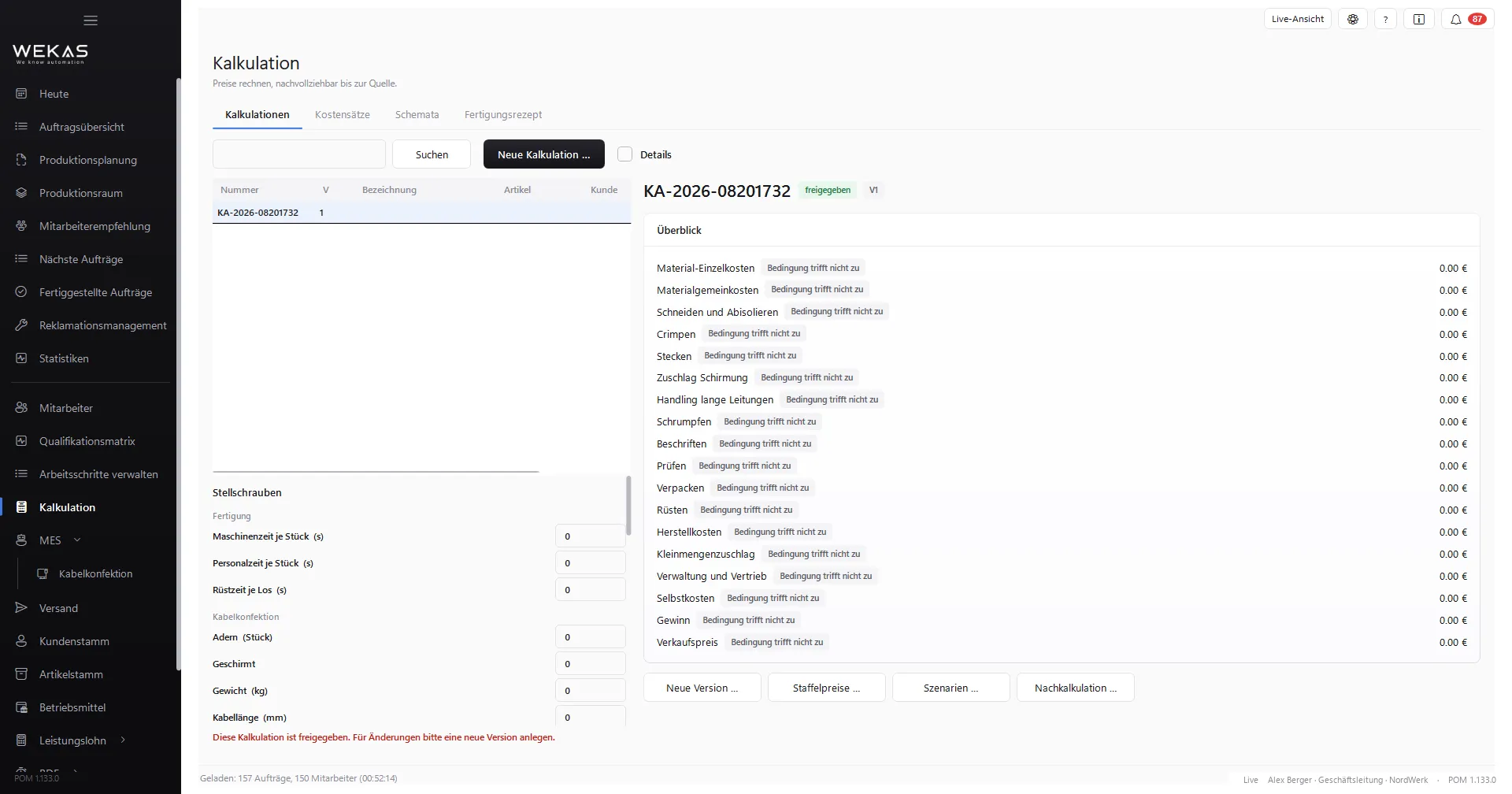
Costing schemes with your formulas: material, labour, machine rates, scales – and post-calculation against reality.
- 01
The problem
Quotes come from a spreadsheet only one person understands. Whether an order earned money is unknown.
- 02
How POM solves it
Costing schemes with cost rates, overheads, margin and quantity scales – and post-calculation that compares plan with the hours BDE actually booked.
- 03
The result
Quotes with a foundation, and per-order profit that is knowledge instead of feeling.
Functions
What is inside.
-
Costing schemes with free formulas
-
Cost rates: material, labour, machine, overheads
-
Margin as mark-up or separate line
-
Quantity scales per article and customer
-
Post-calculation: planned against actual from BDE
Price
One number per tier – not per user.
Module – added individually 10 % saving with annual billing
| POM Costing | up to 5sessions | up to 10sessions | up to 20sessions | up to 50sessions | up to 100sessions | more than 100sessions |
|---|---|---|---|---|---|---|
| net / month | +41 € | +75 € | +135 € | +300 € | +525 € | On request |
| net / month, annual billing | +36.90 € | +67.50 € | +121.50 € | +270 € | +472.50 € |
All prices net, plus statutory VAT. Unlimited user accounts – concurrent sessions are what counts.
More than 100 concurrent sessions: individual quotation – price on request. Request a quote
Quick answers
Questions about POM Costing
What is the difference between costing and post-calculation?
Costing – often called pre-calculation – works out before the order what an article will cost and which price follows: material, labour, machine, overheads and margin according to your costing scheme. Post-calculation then compares plan with reality. POM Costing does both: schemes with free formulas and quantity scales for the quote, and a post-calculation that sets the planned times against the hours actually booked in BDE.
Where does POM Costing get material prices, hourly rates and actual times?
From the master data POM already keeps. Material prices, including price scales, sit in the article master and are maintained by purchasing, even without the costing module; expired supplier offer prices do not count. POM Costing calculates cost rates for employees and machines with a visible derivation. Actual times come from POM BDE: post-calculation finds the bookings through the production order number. Releasing a costing freezes times and material costs; corrections become a new version.
Can I work out from which quantity a target price is reached?
Yes. POM Costing spreads project, batch and unit costs across the quantity scales and shows which share falls with quantity and which stays. The reverse calculation answers which price delivers a desired margin and from which quantity a target price is reached. If the target price lies below the pure unit costs, POM says so and names the lower limit instead of inventing a quantity. Scenarios put variants side by side.
Is POM Costing worthwhile without POM BDE?
For costing, yes: schemes, cost rates, operations with standard times, quantity scales and scenarios all work without BDE. Post-calculation needs booked actual times, which come from POM BDE; without bookings, POM says there is nothing to compare instead of showing zeros. With BDE, POM also suggests standard times – per piece, as the median and only from at least five feedback records. Only a person with the right permission may adopt them.
Optimize
More modules in this category.
POM in your industry
Where POM Costing matters most.
-
Machine building
Single units and small series, long procurement, many trades on one order.
Learn more -
Special vehicles
Project manufacturing with long build times and documentation the customer keeps for decades.
Learn more -
Contract manufacturing
Changing customers, changing parts – margins decided in the quote and defended on the floor.
Learn more
Try every module for 30 days.
During the trial the complete platform is unlocked – afterwards you choose what stays.