

POM Enterprise
Multi-tenancy
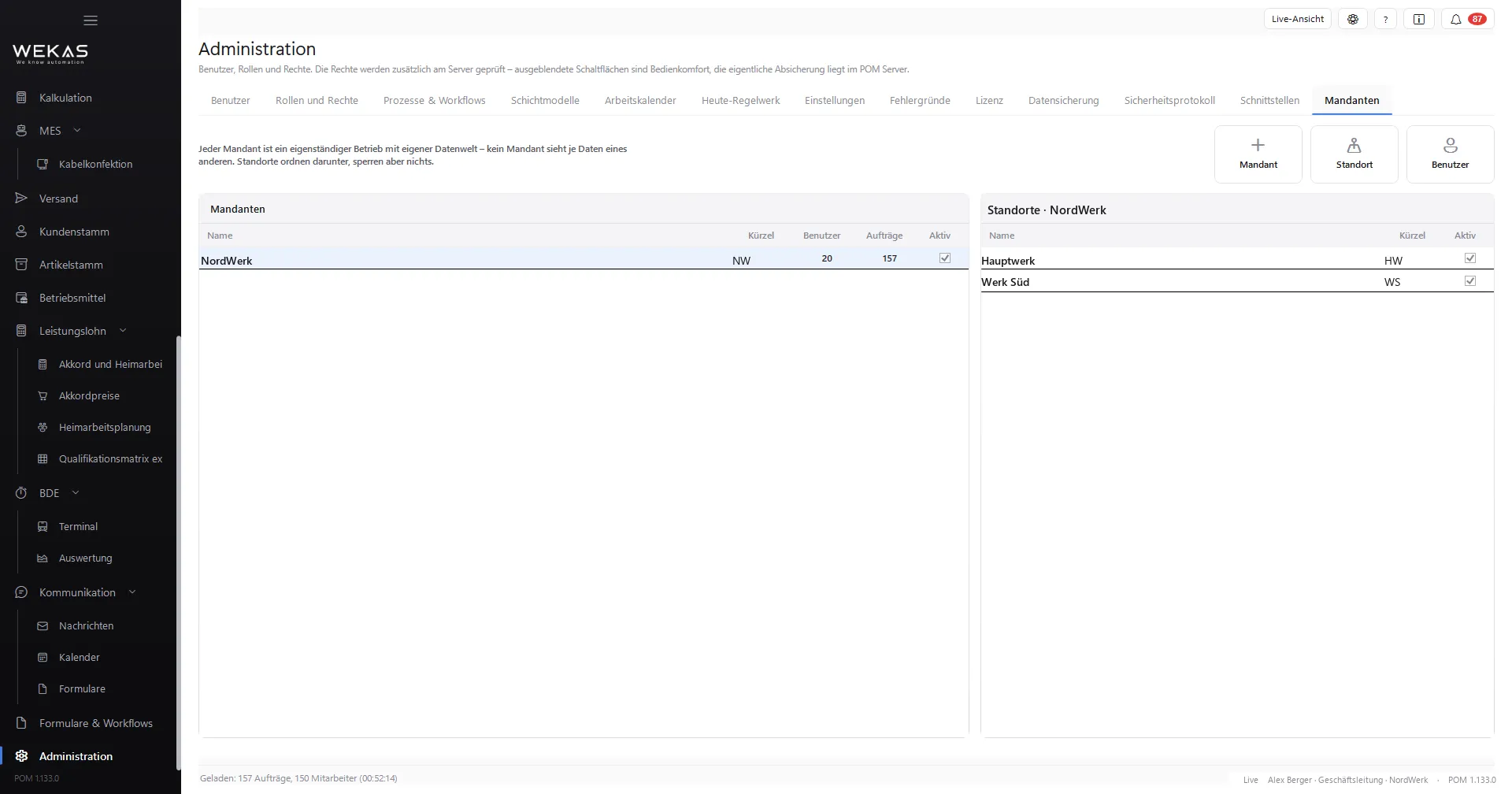
Several companies in one installation: every tenant works with its own, cleanly separated data.
- 01
The problem
Two companies, two installations – double updates, double upkeep, and every change to the system happens twice.
- 02
How POM solves it
Tenants separate the companies cleanly: every tenant has its own data, and no tenant sees another one’s. Yet only one installation on one server needs to be run.
- 03
The result
Every company stays on its own – and IT still looks after just one system.
Functions
What is inside.
-
Tenants with cleanly separated data
-
No tenant sees another tenant’s data
-
One installation and one server for every company
-
Prerequisite for POM Multi-Site
Price
One number per tier – not per user.
Module – added individually 10 % saving with annual billing
| POM Enterprise | up to 5sessions | up to 10sessions | up to 20sessions | up to 50sessions | up to 100sessions | more than 100sessions |
|---|---|---|---|---|---|---|
| net / month | +25 € | +45 € | +81 € | +180 € | +315 € | On request |
| net / month, annual billing | +22.50 € | +40.50 € | +72.90 € | +162 € | +283.50 € |
All prices net, plus statutory VAT. Unlimited user accounts – concurrent sessions are what counts.
More than 100 concurrent sessions: individual quotation – price on request. Request a quote
Quick answers
Questions about POM Enterprise
What does multi-tenancy mean in POM?
Multi-tenancy means several companies work in one POM installation, each as a tenant of its own with its own, cleanly separated data. No tenant sees another tenant’s data; this is enforced on the server, not just in the user interface. Yet only one installation on one server needs to be run – your IT handles updates, backups and the licence once instead of per company.
Which data belongs to just one tenant in POM Enterprise?
The business data people work with – for example customers, orders, users and roles, the piece-rate list from POM Piecework or the carrier connections from POM Shipping. Every module works within the tenant a user is signed in to, and roles apply only there. Companies that also run several sites add POM Multi-Site: sites are maintained in the tenant administration of POM Enterprise, which is why Enterprise is included automatically.
Do I need a separate installation for each company?
No. All tenants run in one installation on your own server, and all workstations use the same database. Your system administrator creates an additional company as a new tenant within the scope of your licence – no second server, no second installation and no duplicate updates. Each sign-in then works in exactly one tenant and sees only its data.
Tenant or site – which one do I need?
That depends on your legal structure. A tenant is a company of its own with its own, separated data; that is what POM Enterprise is for. A site is a plant or part of the business within a tenant, with its own workstations and holiday model, while customers remain shared data of the business. That is what POM Multi-Site is for, and it includes POM Enterprise automatically. A single company at one location needs neither.
Scale
More modules in this category.
Try every module for 30 days.
During the trial the complete platform is unlocked – afterwards you choose what stays.